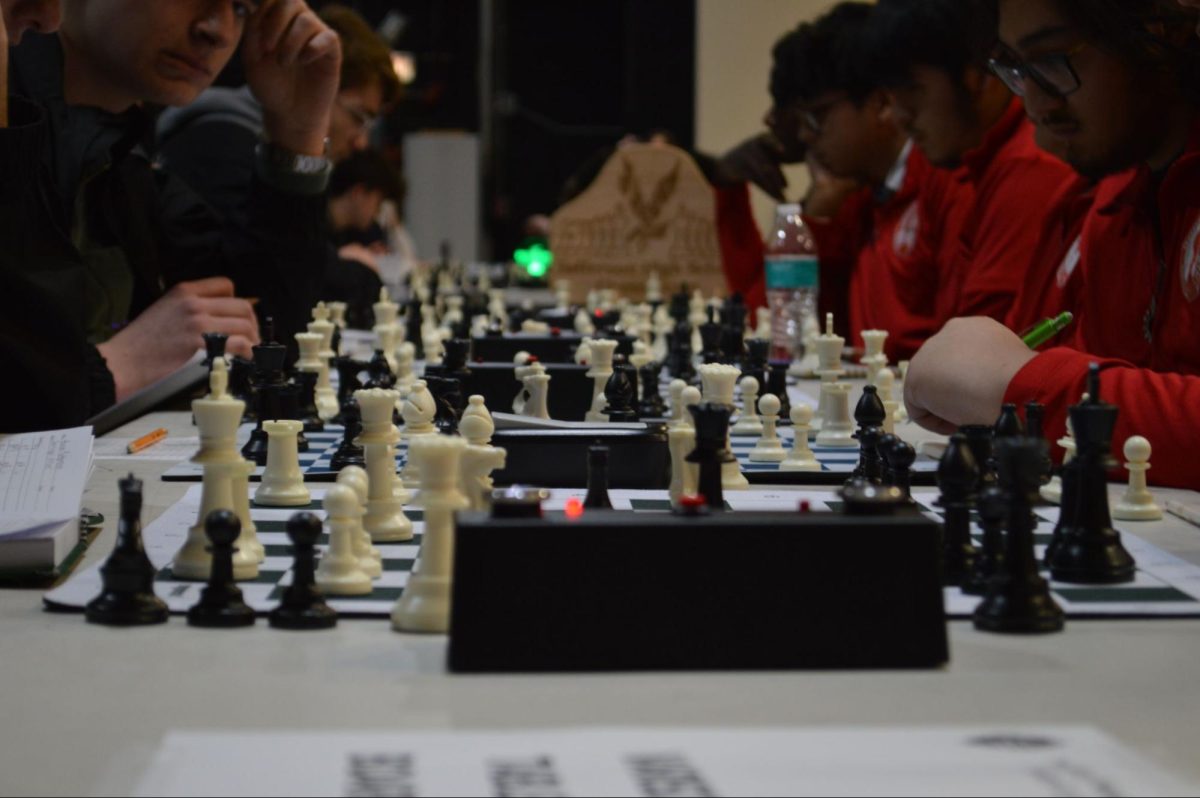
On Saturday, Jan. 17, the Kaneland chess team hosted the Northern Illinois Chess League Conference Tournament in the West Gym of the high school.
They earned third place out of 13competing teams, scoring three total points. This score was shared by Huntley (2nd) and Rock Fall’s (4th) teams, but Kaneland placed third due to their IHSA tiebreak score of 9.37. This marked a slight decline from the previous year’s results, which ended with Kaneland’s team earning second place.
These games are much more competitive than a typical leisurely game of chess with a friend, with each player given an hour of tracked time to strategize and a five-second bonus at the start of every turn. Every single move is also slavishly written down on paper as to avoid breaches of rules. There is also much more team support than in any one-on-one game of chess.
“When I lose, My team is there to help me get back up on my feet and go for another win,” Senior Sean Luqueno-Rodriguez said.
Frequently, when players are finished with their own matches against their designated opponents, players from either player’s team might gather around another two players’ board to watch the game unfold and provide silent support.
The surrounding players dare not make a peep, however, as their teammates need to focus on the intense mental and strategic duel that is competitive chess.
“[Chess is] much more of a strategic game,” freshman Connor Hamilton said. “You have to think a lot about everything you do. It’s all in your head.”
Because chess is such an internal game, the way in which you act and react to stimuli in real life affects the way you play chess.
“How you think is how you play,” Luqueno-Rodriguez said. “Your personality affects [the game]. If you’re aggressive, you’ll play aggressively. If you’re sneaky, you’ll play sneaky. If you’re patient, you might see something you wouldn’t have otherwise that helps you win the game.”
However matches eventually end, there is only one person who can come out victorious, barring a draw. And sometimes, that winner won’t be you. During these difficult moments, some like Luqueno-Rodriguez turn to their team. Others think back to those who inspired them to try chess to begin with.
“My dad has always been a chess player,” sophomore Bryce Ehlers said. “His encouragement pushed me to get involved.”
So despite some setbacks, the chess team comprises a variety of increasingly smart and tactical minds. And with every match , they get better and better for the next game.