As high schoolers discover who they are becoming, their values and beliefs may change and they may begin to question their surroundings. Their developing knowledge about important topics, along with their Constitutional rights, allows for self-expression and freedom of speech.
The answer to whether or not First Amendment protections should apply in schools differs depending on whom you ask. Many argue that those rights should not be restricted, while others argue that certain topics have no place in classrooms and hallways.
Although students do have a right to freedom of speech and expression, the school environment creates a unique policy for what can be said, worn, displayed and done. The Supreme Court decision in Tinker v. Des Moines (1969) that protected students wearing an anti-war arm bands created the standard that an act or speech which does not impede teaching or harm others is protected under the First Amendment.
When student voices protected by the First Amendment are silenced, it brings up the question of censorship.
It can be argued that censorship is important in order to protect vulnerable groups and control hate speech. However, censorship is illegal in the United States when the government attempts to restrict protected speech.
In early February, AP United States Government and Politics students were asked to create a polling project to learn optimal polling practices. In order to collect answers for their polls, students sent them to administration in order to have someone in a position of authority share the polls with all students.
Junior Henry Nguyen created a poll to ask students if they preferred last school year’s administration or this school year’s administration because there have been new staff members and changes in policy. His poll was never sent to students, and the administration did not give him an explanation.
“The only way this kind of situation improves is by communication,” Nguyen said. “Any attempt of action or change falls flat immediately. I do understand that everyone has their own duties and responsibilities, but to be left in the dark for multiple days while relying on the front office to do a summative project is borderline unacceptable.”
This situation caused Nguyen to question whether it was a circumstance that lacked communication or rather represented an act of censorship.
On Friday, Feb. 20, senior Janel Gutierrez was told by administration that her skateboard art project could not be displayed in the hallway alongside her classmates’ projects. Gutierrez’s skateboard brought awareness to the names of people killed by Immigration and Customs Enforcement (ICE) during ICE operations, along with a situation with ICE involving young child Liam Ramos. The skateboard also featured sayings like “ICE OUT,” “No one is illegal on stolen land,” and a statement in Spanish that included profanity.
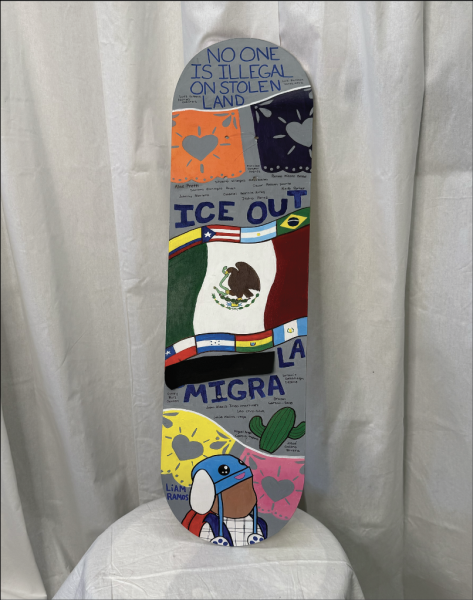
Initially, art teacher Emily VanDelinder-Birchfield suggested censoring the profane word in order to avoid conflict, and Gutierrez covered the first two letters of the word. The art piece was displayed halfway through ninth period, but administration facilitated its removal by the end of the school day.
“Once I got frustrated that I wasn’t getting answers, I felt that [the issue] was personal,” Gutierrez said.
To Gutierrez, the reasoning behind the removal is unclear, given that the profanity was censored before her skateboard was displayed, and it is even further clouded when assessing the projects alongside it. Gutierrez’s project was not the only piece that represented personal values, as multiple skateboards which were not removed involved religion, such as angels and crosses.
“To me, that only leaves the question, ‘Why censor the voices of students unless it’s something you’re scared of students thinking about?’” Nguyen said.
Although immigration has been a very controversial topic, silencing student voices does not avoid conflict. Rather, it makes students feel targeted and underrepresented. During times of intense conflict and abuse, any and every voice is essential to creating change and deserves to be heard.
“Administration went straight to the school handbook on innapropriate language,” VanDelinder-Birchfield said. “Their stance was it’s the same as if the student was wearing a shirt that has a bad word on it, they’ll have you change into a different shirt, not just block that word off.”
School should be a safe environment, where diverse ideas and opinions are welcomed, not solely the ones some agree with. Unfortunately, this is not the reality of our society, and we are not usually accepting of ideas that do not align with collective values.
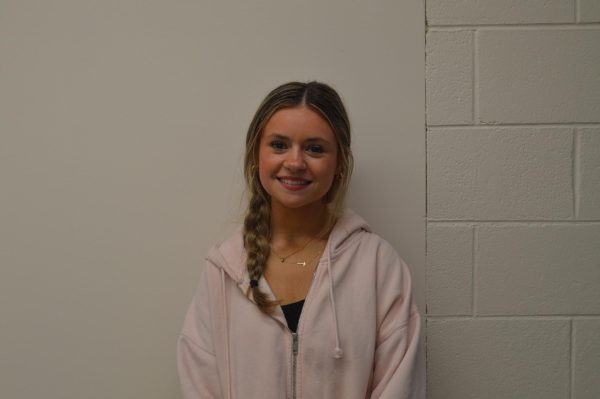
Senior Gabriella Monteleone used to support the Trump administration at the beginning of President Donald Trump’s second candidacy and has worn a sweater with Trump’s name on it, causing her to receive negative comments from her peers and feel targeted by her entire class.
“It was so bad to the point that I had to take the name off the sweatshirt because throughout the entire day I just did not feel safe expressing that I was a Trump supporter,” Monteleone said.
Although Monteleone’s opinion on the administration has changed, she felt uncomfortable expressing her First Amendment right at school.
The First Amendment has allowed us to fight for civil rights, demand change and express our concerns. Although we may be young, we should not be intimidated by others when it comes to fighting for our liberties, advocating for others and defending our values.