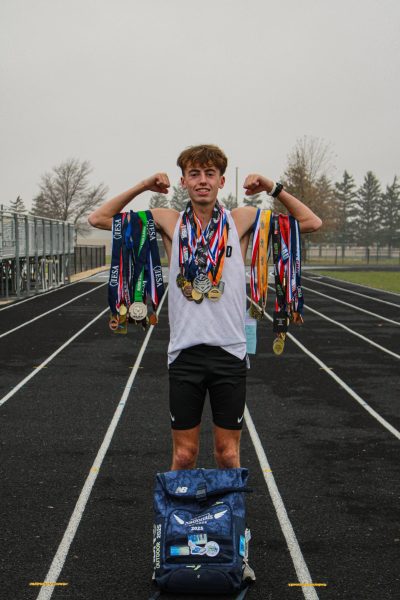
When sophomore Carson Kaiser steps up to a starting line, he doesn’t just look like someone ready to race. He looks ready to attack. Beneath the calm focus, the Belgian waffle pre-race rituals and the playlists full of house, rap and ‘90s rock, Kaiser carries an intensity that has helped make him one of Kaneland’s fastest rising distance stars.
Kaiser’s path to becoming a top runner wasn’t a childhood dream or a family tradition; it was an obligation.
Before running became a passion, it was simply an expectation placed on him. Kaiser remembers that moment clearly, standing at a crossroads where he had to select a sport, not out of excitement, but necessity. What began as reluctant participation slowly shifted as he discovered structure, improvement and the satisfaction of pushing himself. That first nudge from his parents ended up setting the foundation for a journey that would reshape his identity.
“I wasn’t doing a sport at the time, and my parents said I needed to,” Kaiser said. “Cross country was the pick over tennis.”
Born in Oregon, raised in Oklahoma and St. Louis, and now settled in Sugar Grove with his parents, twin brother and dog, Kaiser has learned to adapt to change.
New schools, new teammates and new expectations forced Kaiser to adjust quickly, and he now treats challenges on the course the same way. Despite the changes, his family remained the grounding force, the people who reminded him to stay humble, focused and accountable.
“My dad has always just asked me to try my best,” he said. “If I don’t do that, then I’m wasting the gift that I do have.”
That mindset has fueled a rapid rise. His cross country head coach, Chad Clarey, said that after a strong freshman year spent “surviving” the mileage, Kaiser took a major step forward as a sophomore.
Clarey said Kaiser became noticeably more analytical about his training this year. Instead of simply completing workouts, he began studying them, asking about pacing windows, effort zones and tactical execution. That deeper understanding, according to Clarey, allowed Kaiser to train with purpose and consistency that set him apart from most athletes his age.
“He’s running workout times we’ve not had before as coaches,” Clarey said. “He’s ultra-aware of his paces and how his body is responding. He’s eager to push his limits because he wants to improve and chase his goals.”
His teammates witness that drive every day. Training with Kaiser, junior teammate Nolan Reutimann said, is like stepping into a moving stream: you either stay with him or get left behind.
Reutimann said that even on the hardest days, Kaiser brings an energy that makes others follow. He mixes intensity with levity, often sharing stories or jokes during runs that help the miles pass faster. Those moments, teammates say, are a part of what makes him a leader. Kaiser knows when to push, but he also knows when the team needs to laugh.
Reutimann describes Kaiser as “funny, dedicated, encouraging and slightly eccentric,” someone who makes even the longest runs enjoyable.
Off the course, Kaiser looks different from the intense racer people see. He draws nearly every day, a hobby he’s had since age eight.
“My drawings are inspired by music, shows, movies…pretty much pop culture,” Kaiser said. He has even built a small following on TikTok and runs a YouTube channel, Carson X Kaiser, which he jokes that most people don’t know about.
Despite his success, the pressure still gets to him. He admits that he gets anxious before big races, especially in the postseason. Clarey helps him create short “power phrases,” such as “be strong” and “attack” to center his mindset.
Kaiser said the phrases help keep him grounded when his nerves spike. He repeats them quietly on the walk away from his team and to the starting box, using them as reminders to stay calm, trust his preparation and focus solely on the race ahead. Over time, those phrases have become anchors, guiding him through some of the biggest moments of his career.
“When we feed our brain the positives in a hard situation, we can succeed,” Clarey said.
Kaiser embraces failure rather than fearing it. He believes setbacks are valuable tools, not roadblocks. After every race, good or bad, Kaiser revisits what happened, breaking down his pacing, effort and execution. The tougher the race, he said, the more opportunity it gives him to grow. That willingness to confront imperfections is one of the reasons he continues to progress.
“I use all the bad stuff that’s happened to me as part of my arsenal going into training and races,” Kaiser said.
That approach became crucial during last spring when knee tendonitis threatened to derail his season right before Nationals. For the first time, he worried that he might not make it to the starting line. The fear of missing a major opportunity forced him to confront his limits, both physically and emotionally.
Clarey believes the next few years hold almost limitless potential. He said that Kaiser’s combination of talent and values333 sets him apart from most runners his age. If he continues to grow at this pace, Clarey believes Kaiser has the potential not only to break records, but to redefine what’s possible for a Kaneland distance runner.
“There’s no telling what he’ll accomplish,” Clarey said. “He wants to become the best distance runner in Kaneland’s history. That’s meaningful, given the history this school has had.”
Kaiser knows that story is just beginning. He says the moment that best captures who he is happens during workouts, when he encourages his teammates after a tough rep or race.
“Everyone needs someone to say what’s up and keep them going,” Kaiser said.
Sixteen years in, Kaiser says he’s still writing his story. And if he had to title it?
“Carson Kaiser vs. the World.”